
If you are looking to develop module-level outcomes that align with your course-level outcomes (CCNS Competencies), here’s a step-by-step guide to help you through this process, utilizing Bloom’s Taxonomy for effective learning outcome creation:
- Identify the CCNS Competencies
- Review the course-level outcomes to get a clear understanding of the competencies students are expected to achieve by the end of the course.
- Review the setup of modules your course
- You must have at least one learning objective for every module, regardless of whether your course is organized with modules for each week or each unit.
- Identify how students will be able to demonstrate what they’ve learned in each module.
- What are the main things students are expected to learn in each week or unit? What assessments or activities do you have students complete in the module, and what are they expected to do?
- Bloom’s Taxonomy can help you find a verb that will match the level of thinking students are tasked with completing in your module.
- View example learning objectives.
- After creating the learning objective, double-check that the module-level outcome is measurable and aligns with the assessments and activities planned for the module.
Bloom’s Taxonomy #
Bloom’s Taxonomy is a hierarchical framework developed by educational psychologist Benjamin Bloom and his colleagues in the 1950s. It categorizes cognitive skills into six levels, ranging from basic to advanced. This taxonomy helps educators structure learning objectives, assessments, and activities to promote higher-order thinking skills.
The Six Levels of Bloom’s Taxonomy: #
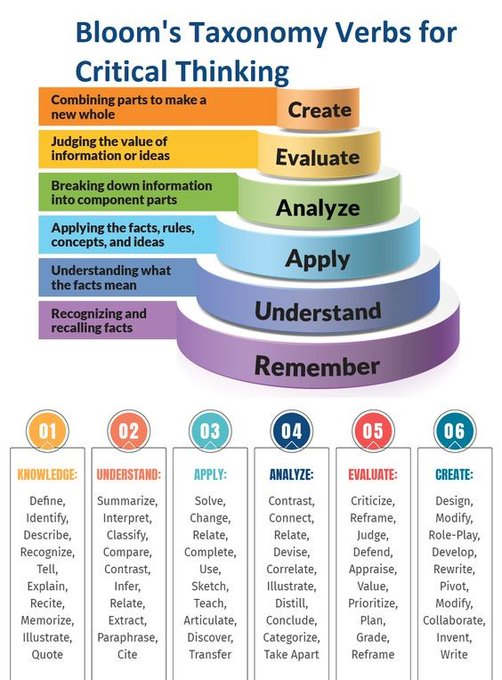
How Bloom’s Taxonomy Helps Create Learning Objectives: #
- Clarity and Precision: By using specific action verbs associated with each level, educators can create clear and precise learning objectives that specify what students are expected to achieve.
- Alignment with Assessments: Learning objectives based on Bloom’s Taxonomy can be directly aligned with assessments, ensuring that the skills being taught are the ones being evaluated.
- Structured Learning Progression: The hierarchical nature of Bloom’s Taxonomy allows for a structured progression of learning, where students build on foundational knowledge and skills as they advance to more complex cognitive tasks.
See more information about Bloom’s Taxonomy.
Example Learning Objectives #
Art:
- Create a portfolio showing skill in different art techniques.
Automotive Technology:
- Diagnose and repair common automotive electrical system faults using diagnostic tools and repair manuals.
Biology:
- Explain cellular respiration and its role in energy production.
CAD (Computer-Aided Design):
- Create a 3D model of a mechanical part with correct dimensions.
English:
- Analyze themes in 19th-century American literature using evidence from the text.
Humanities:
- Evaluate how Renaissance art influences modern culture with examples.
Interior Design:
- Design a residential space using color theory and spatial planning.
Mathematics:
- Solve quadratic equations and graph the solutions.
Nursing
- Assess patient needs and develop a care plan based on clinical guidelines.
Welding:
- Perform a horizontal fillet weld to meet industry standards.


You must be logged in to post a comment.